
Elegant Wedding Cake Cart in A Luxury Reception Setting
The top-tier wedding furniture doesn’t merely function. It, essentially, is the focus of people’s awe. Enter a cake wagon where it seems to have its own force of nature—people stop what they’re doing, take pictures, change their talks and head to that side of the room. That power to attract people, however, is not accidental. It is carefully planned in the facets, the edges, and the intentional metal curve against the simple line of a serving tray.
Form is the unspoken language of posh events. An elegantly crafted cake cart is a talker before the very first cut of cake; it is actually the mood and the expectation that get communicated just by its outline. For planners having to manage demanding and complex events and for couples spending their money on their unforgettable moments, the furniture they opt for becomes a way of memory. This explains why a vehicle resembling an art piece for the functionality of the wedding, rather than a piece of standard convention-center equipment, getting its place in the final photo sequence is the reason which is most important.
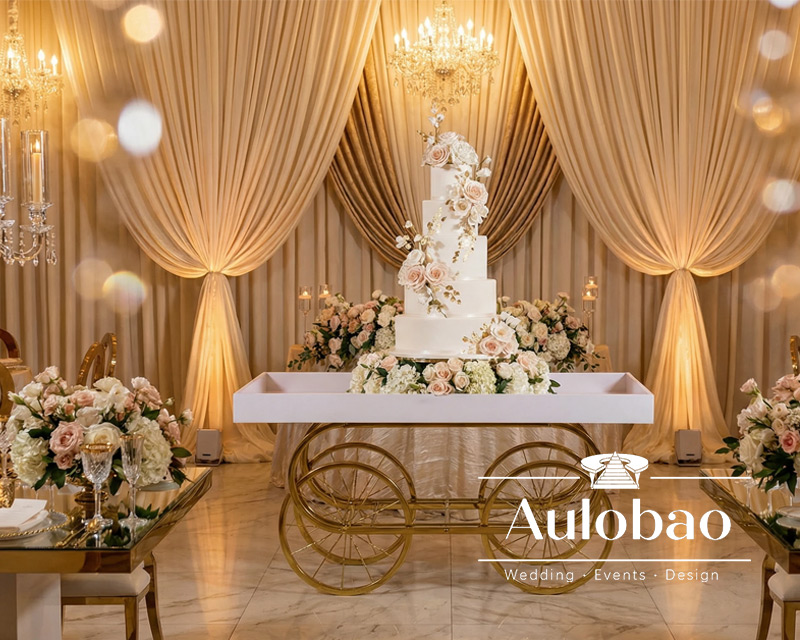
The Wheel as Ornament and Anchor
If you examine the bottom of this cake cart closely, you will understand how the four large wheels made in gold metal and designed with a nod to 19th-century carriage style convey the meeting of heritage and invention to the world. Along with being the wheels that carry the structure, they are also art pieces. The radiating lines from the center of the wheel create the negative space, which makes the solid frame look like it is floating. It’s a trick of visual weight: the more transparent the wheel design, the less the cart seems to be fixed to the floor.
That lightness is very important in the cramped space of a reception. A cart with heavy, solid wheels looks like it is firmly rooted and cannot be moved. Spoked wheels, especially those made of thin metal tubing, evoke the idea of being able to move, being elegant, and the possibility that this piece might be able to glide over polished marble as easily as it can be photographed. For event planners in charge of the ballroom corners or outdoor terraces, the implied mobility changes the way the piece can be integrated into the flow of the event. Guests see it as approachable rather than fixed, which is a subtle way of inviting them to interact and take photos from different angles.
Curves That Sculpt Space
The frame that extends from the spokes of those wheels is made of curves that flow. These are not the geometrical shapes of angles welded together. Rather, the tubular metal is curved along compound curves—curving one way, then the other, following the shape of an hourglass that at the middle is narrowing and then again opening to hold the serving tray. Essentially, the silhouette is more a wrought-iron piece of Art Nouveau than a catalog of industrial furniture.
Those curves perform some practical tasks. The inward taper at mid-height not only gives the visual rhythm but also helps to see the cart breaking up the boxy shape, which could have been there without this. The outward swell at the top, besides stabilizing the wide platform, also helps in distributing the visual weight so the tray is not the one that looks like it is going to teeter. And the single—there are no harsh corners, no abrupt changes—line, which thus hand-in-hand with the eye connects in a loop, the so-called oblique angles from which the piece is photographed still keeps the room going with the help of this line.
The cart, with the help of these soft curves, visualizes the space in a different manner for venues having strong architectural lines—marble columns, coffered ceilings, and geometric tile. Curves humanize the spaces, still giving formal rooms an organic flow, which they might have otherwise become too stiff. The event stylist’s decision on the shape is one that they notice: In a ballroom filled with straight edges, the cart that curves is the room’s punctuation mark.
The Tray as Stage
On top of all this metalwork stands a clean white rectangular tray. It is intentionally minimal—no embossing, no ornamental edge, just a clean field with a subtle raised lip. The restraint is strategic. The tray acts as negative space, a visual palate cleanser that allows the cake (and the floral arrangements, the candles, the styling details) to take up the whole focus.
The proportions are important. The tray is long enough to hold a multi-tiered cake plus accent pieces—petit fours, florals, signage—without being too tight. But it is not so large that it makes the frame below look tiny. The balance keeps the cart reading as an integrated object rather than a tray that is awkwardly perched on a stand. For planners staging a cake-cutting ceremony, this is the whole cart photographed as one single composition, not a collection of parts that are fighting for attention.
That white surface also interacts with light. In reception spaces that are illuminated by chandeliers, uplighting, or window walls, the matte finish softly diffuses the highlights, thus avoiding the harsh reflections that can blow out the photographs. It is a small detail, but one that wedding photographers are thankful for when they are after the perfect backlit cake portrait.
How the Parts Become Whole
Put your eye away from the details and the cart shows you its fundamental feat: proportion. The size of the wheel, the height of the frame, and the width of the tray – each measurement adjusts to the others to make a product that doesn’t seem either too heavy on the top or too short. It is the type of equilibrium that is not noticed until it is absent. A tray one inch wider would make the bottom look smaller. Wheels one inch smaller would take the cart in the direction of toy-like whimsy instead of stately elegance.
This proportional control also extends to material contrast. The warm gold metal frame color stands against the cool neutral color of the white tray, creating just enough tension for the eye to be engaged and not to clash. The interaction indicates the use of the piece in different settings—use it with ivory linens and blush florals to get soft and romantic or put black accents and moody lighting to get dramatic. The shape does not predetermine a single aesthetic; it is an opening for the range.
That adaptability is very valuable for event professionals. A furnishing that looks great in the photos, irrespective of the styling, thus from garden-party pastels to industrial-loft minimalism, is worth its rental fee several times over. The shape turns into a neutral stage, which subtly shows off the other elements rather than competing with them; hence, this is what makes it of professional-grade rather than decorative novelty.
Designing the Moment
In the final analysis, a wedding cake cart is the framework for memory. The wedding cake cart is the piece of furniture that puts the cake at the level of the eye, that beckons the couple to stand next to it for that ceremonial first cut, that stabilizes the corner of the reception in a manner the guests will later refer to as “elegant” or “stunning” without giving the reasons. It is the form that is doing that job—silently, effectively, with a lexicon of curves and dimensions that indicates the fluency of the luxury events.
For planners and designers who are sourcing pieces that need to perform across venues, seasons, and client aesthetics, shape is the factor that decides whether the work will be successful or not. This cart, with its carriage-inspired wheels, its sculptural tubular frame, and its restrained white platform, visually represents the kind of presence that can elevate any reception space without the need for a specific theme. It can be used in black-tie ballrooms as it is elegant, in garden ceremonies as it is approachable, and in final albums as it is photogenic.
Do you want to raise your event to a new level? Auloba Furniture is the place to find not only this cake cart but also the complete collection of wedding and event furniture. The furniture your clients choose is not just décor—it’s the architecture of their most precious moments.
About Us
We have been doing wedding furniture for 16 years. We are professionals in the collection of all kinds of wedding furniture. We also have a 3D design team, which can design different scenes for you. If you are interested, please pay attention to our website and feel free to contact us.
——————————————————————————————————————–
IF YOU ARE INTERESTED IN OUR WEDDING AND EVENT FURNITURE
Choose Aulobao furniture, which will make you comfortable and satisfied.
Welcome to contact us to get the latest product catalog and price list!
Please follow our Instagram or Pinterest or TikTok to get more latest news.